Wednesday, April 24, 2024

Gondor the Beast


The Story of Gondor the Beast

By Jeffrey M. Bowen

A strange creature  inhabits our backyard. He is a 350-pound concrete beast with fangs,  wings, and eyes that seem to glow in the twilight. After eight years, he has become an old friend who reminds us why we love to scare ourselves.

His name is “Gondor,” which is the term J.R. Tolkien used to describe the Middle Kingdom in his famous trilogy.  This moniker won first place in our own facebook contest, but our creature’s  formal name is a gargoyle or chimera.  The former term sounds like gurgle or gargle for good reason.   Gargoyles are the grotesque offspring of Gothic church architecture in the Middle Ages.  They are fantastical creatures who perch on steeples and steep rooftops.  Their mouths are spouts to drain rainwater off the roof and sides of a building.  

 On the other hand, chimeras seldom have spouts, but they are nonetheless nasty looking Greek mythological beings composed of animal parts – lions, goats, dragons (wings) with a snake-headed tail.  Gondor is one of those snarling hybrids, crouching on his haunches, resting on huge claws, and baring fangs.

 The Notre Dame cathedral in Paris is a favorite haunt for chimeras that were sculpted in the 1800s.  Hundreds of years earlier, so the story goes, a dragon-like beast would rise from the Seine River and eat terrified residents with grisly abandon.  Helped by a Catholic saint, enraged citizens trapped and burned the dragon.  However, his head and shoulders resisted flames, so instead his hide was nailed to the church to ward off evil.

Today the biggest numbers of chimeras and gargoyles can be found on Catholic churches. across France.  They also sit on city rooftops in places like New York City, Pittsburgh, and Chicago.  American horror novelist Stephen King insists that they are quite alive and always watching us from above.  

Our own story of Gondor began eight years ago when we visited our daughter in Albany.  She suggested antiquing at a downtown salvage yard.  There we discovered a demonic statue who looked like he might have flown in from the rooftop of a nearby Albany church or office building.  Fatefully, I remarked, “Wow what a birthday present he would be sitting in our yard back home!”

My wife and daughter mischievously hatched a plan to ship the creature 300 miles across the state to our rural home.  My son-in-law Bill arranged to have the beast hoisted and lashed onto the bed of his truck.  Out on the thruway gawkers would pull even, wave and laugh at his fierce cargo. I thought the chimera’s arrival was the best possible birthday.  Several husky friends wrestled my unusual gift onto a convenient concrete pad.  Today, years later, he stares balefully at anyone who passes by. 

In recent decades grotesques have become amazingly popular. Their shock value has diminished, but their entertainment value has skyrocketed.  They show up as Disney cartoon characters or beings that invade from other planets.  My favorite classic horror show is the 1984 “Ghostbusters”, starring actor Bill Murrey and friends. Two mythical figures, the keymaster and the gatekeeper, combine evil forces to occupy a city rooftop and unlock the gates of hell.  Like many other chimeras, the keymaster’s “terror dogs” break out of their shells and raise havoc.  Ultimately, they are exploded by the laser guns of the ghostbusters who rescue the city.  After four iterations, ghostbuster movies have become a cultural phenomenon.

From Gondor to Ghostbusters, the popularity of grotesques begs the question, why has it become such a thrill to scare us out of our wits? Monstrous characters have almost become our heroes and friends.  The spiritual message of repenting in the face of horror has worn off.   Words like enticing, mesmerizing, and addictive come to mind.   We have gotten used to real and fictional grotesque happenings all around us.  Still, we take comfort in knowing that Gondor is alive and watching for evil invaders.  


Thursday, February 22, 2024


Reading To Children Is Time Well Spent

By Jeffrey M. Bowen

At three years of age, I spent hours on my grandmother’s lap mimicking the nursery rhymes she read aloud.  Humpty Dumpty, Jack and Jill, and the cow who jumped over the moon became my earliest childhood friends as she helped me trace the words and pictures on every page.  My dad tape recorded those expressive recitations.  The memories have endured for years.

I marvel at the influence of those early oral reading experiences. I was fortunate to have a family who appreciated reading aloud as a critical tool for developing literacy and for pleasure. Recently, a nationally representative sample survey of nearly 10,000 four-year-olds found that 25 percent are never read to, and another 25 percent have this experience only once or twice weekly. Yet the American Academy of Pediatrics strongly endorses the practice in early childhood because it “builds language, literacy, and social-emotional skills that last a lifetime.”

The joy and value of listening to someone read aloud is well understood by teachers, but in elementary school it gets crowded out by the “science of reading.”   Over the last decade 37 states have passed laws and policies that call for “evidence-based” literacy instruction. The term has become a slogan that applies to many different scientific elements of reading proficiency.  Few teachers are prepared to make field-tested measurement-driven methods work in their classrooms.

Our state’s current executive budget proposal includes $10 million for districts to train 20,000 teachers in the science of reading. Governor Hochul is embracing a politically appealing dedication to phonics instruction.  In other words, first teach children how to decode, that is to connect letters with sounds, and to translate sounds into speech. Spelling and word meanings play an important part.  The Governor is not wrong, but a balanced approach to literacy must also incorporate comprehension.  

Surely it is important for children to develop a vocabulary, but applying it calls for hitching it to knowledge and understanding of content. A child may be able to read words perfectly and not be able to tell you much of anything about the story behind those words. The skills and strategies of reading are strengthened when attention is given to comprehension which enables children to grasp meaning and fit it into new situations.   

We have many reasons to worry about children’s declining reading skills. The pandemic chronically disrupted classroom instruction. Reading proficiency scores hover at an all-time low. The same is true for math, for which reading literacy is also vitally important. Hours spent on screen time and segmented electronic content add to children’s loss of concentration and sustained reading stamina.

 Elementary teachers highly value the time they spend reading from books rather than so-called basal readers.   Instead of relying on packaged anthologies with disconnected exercises and workbooks, teachers who link their curriculum for science or social studies to oral book chapters of nonfiction find their students are more engaged and motivated.  With copies in hand, the children can read along with their teacher.  Often, they are inspired to find and read books on their own, something every school media specialist appreciates.

Parents and grandparents of preschool children can enrich their children’s almost intrinsic love of stories and their amazing absorption of vocabulary long before kindergarten.   Nursery rhymes were my introduction to literacy.    Years later, my wife and I spent many hours reading stories to our children from books like “Blueberries for Sal”, “Barbar the Elephant” and “Curious George,”. There is a reciprocal benefit to reading with your child or grandchild.  Not only does it grow their vocabulary and awareness of the world, but it reinforces parenthood in ways that last a lifetime. 


The Crisis of Misbelief

By Jeffrey M. Bowen

Lately it seems as though we are drowning in daily tides of misinformation and deceit. Our daily newspapers and social media seem to compete as they flirt with conspiracy theories. Outlandish distortions of fact are now repeated with gusto. The topics typically highlight the suspected evil intentions of federal agencies and elected officials. The frame factors usually include politics and litigation. Topics include COVID and health issues, insurrection and stolen elections, immigration chaos, terrorism and warfare, environmental abuses, sexual crimes and sundry coverups.

History and science have become propaganda in the hands of individuals who invent either past or current evidence of misdeeds by powerful and secretive groups. Not long ago I used to marvel and chuckle at the outrageous headlines of trashy newspapers posted at the grocery checkout counters. Nowadays, much to my chagrin, the claims have become the grist of national news from all kinds of respectable outlets.

As the extremes of opinion have grown into screams of injustice, I worry that repetition may erode the ability of our systems to solve problems. How did we arrive at this sorry junction? What can we learn from the dilemma, and what can we do about it?

Troublesome obstacles come to mind. First, when differences of opinion grow extreme, often we ignore or suppress them to avoid conflicts. Long ago we found that national politics can no longer be discussed freely without alienating friends or family. Second, people stubbornly resist changing their basic beliefs even when proverbial writing is on the wall. Instead, they distrust advocates and their motives. Finally, the relentless static of egregious rumors and exaggerations undermines our trust in people and institutions.

 Psychologists are constantly trying to untangle the roots of misbelief. The problem exceeds just accepting falsehoods. Rather it is a mindset or a process that can lead us astray with potentially disastrous results. Dan Ariely, a Duke University professor who has studied reasons why rational people behave irrationally, compares the process to a funnel. At one end it starts with a few nettlesome questions but once captured at the other end we willingly embrace terrible conspiracies. Ariely admits we all share misbeliefs because we are skeptical, recognize bias, and have significant questions about untested claims. However, what overcomes our suspicion is the cumulative drum beat of unchallenged contradictions. 

Misbelieving can be categorized as emotional, cognitive, personality, and social, according to Professor Ariely. Emotional sources center on stress and fear. An example is anxiety about the negative consequences of vaccines, particularly COVID. To regain control, stressed out individuals may latch onto a scapegoat like China.

Cognitive elements come into play when an event or situation becomes so confounding that we forfeit reality and default to conclusions we want to come to. As the saying goes, do not confuse me with facts.

As for personality, a helpful index for me is a zero-sum bias. The idea derives from game theory, but when applied to personalities, it describes individuals who feel they always must win, while others may lose entirely as a result. Winning halfway is not enough.

The social dimension of Ariely’s funnel involves the power of social networking. Many of us depend on such networks to share and reinforce our beliefs. Especially when ostracized by a group, if we crave acceptance strongly enough, we are apt to cave in. Nothing breeds wrong-headed thinking more effectively than depending on the power of us-versus-them.

There is no cure for chronic misbelieving. However, you may want to consider the following bigger pictures:  

Choose sources of information for consistent reliability and ample proofs. Another is to join with others whose declared purposes are to cooperatively reverse well recognized injustices with specific, reasonable steps.

 Make efforts to understand how institutions get things done. An obvious example is exercising our rights and privileges in a democracy by voting, communicating opinions via legal and sanctioned channels, and then accepting the outcomes.

 Develop an understanding of why we rely on institutional policies and procedures and rules, with an accent on how they can be changed for the better. It is tempting to condemn bureaucracy for what it seems to prevent; however, a different picture develops when we consider how bureaucracy can ensure fair and equitable practices and effectively generate positive outcomes given patience.

 Here are a few specific strategic recommendations:

·        ask questions and hypothesize based on solid research instead of simply declaring and affirming assumptions;

·        practice balanced reasoning by thinking through both pro and con sides of an issue;

·        stop believing we know more about an issue than we truly do;

·        avoid the use of labels such as conservative and liberal;

·        choose credible heroes rather than blaming villains;

·        opt for face-to-face listening rather than impersonal electronics;

·        separate and weigh intentions rather than jumping to conclusions.

And finally, to preserve sanity, focus on your own mental health and evaluate it carefully in others.


Friday, December 15, 2023


The All-American Musical Instrument

By Jeffrey M. Bowen

If you were asked to name the quintessential American musical instrument, think banjo. Think of hillbillies enlivening a bluegrass festival or a country folk revival, or the sad background strumming of a PBS video Civil War documentary.  My personal memories include Appalachian backwoods dueling banjos in the classic movie “Deliverance,” and the musical mischief of the Spike Jones band back in the 1950s.  Ask Alexa to play banjo music and fast-tempo country sounds will be launched.  

Historical roots are found in West Africa, and to a later extent in European traditions. The earliest models arrived on 18th century slave ships often landing in the Caribbean.  Music historians describe primitive types as gourds covered with animal skins and necks made of sticks without any frets.  Modern banjos have four or five steel strings. The older types have a fifth short string called a drone or thumb string which is used to play rhythmic upbeats to accompany the main melody.  

Recently I took a close look at a banjo inherited by my brother-in-law Jim Horky. It is built on a circular frame consisting of a resonator and neck.  The essential element is a hollow rim covered with a membrane.  The resonator amplifies the sound. Many diverse types of wood are used in construction, ranging from maple and walnut to mahogany. Different woods yield brighter or richer sounds.

What intrigues me about the one my brother-in-law inherited is that the entire rim is lined with heavy and sturdy metal. This was added to protect the life of the instrument.  Apparently it needed to be rugged. Along with a mandolin and guitar, the instruments were bequeathed to my brother-in-law by his uncle Gerhard Martis, a multi-talented musician from Nebraska.

Gerhard (1897-1956) was a worldwide musical traveler who played in big and small bands in the 1930s and 40s.  I was told that Phil Harris, a very popular band leader of the era, rewarded Gerhard with a nice plot of land near Hollywood Boulevard, but it went into arrears because he could not be bothered to pay taxes on it.

Gerhard was a handsome fellow who could play about any stringed instrument in an orchestra. A photo suggests that one of his gigs involved the SS Niagara as it cruised from Sidney, Australia to New Jersey. My brother-in-law inherited Gerhard’s banjo partly because he, too, is musically talented. It pleases both of us to think that what Gerhard Martis left behind is American musical history to our ears.  


Thursday, December 14, 2023

Living the Legacy of Greece


Living the Legacy of Greece

Recently I read an amusing account of sixth grade answers on a history test. It gave me a laugh but also reminded me of how strangely we interpret the past when context or background knowledge is missing.

One student wrote, “The Greeks were a highly sculptured people and without them we wouldn’t have history. The Greeks also had myths. A myth is a female moth.” Another gave Socrates a sparce obituary when he wrote, “Socrates was a famous Greek teacher who went around giving people advice. They killed him.”    

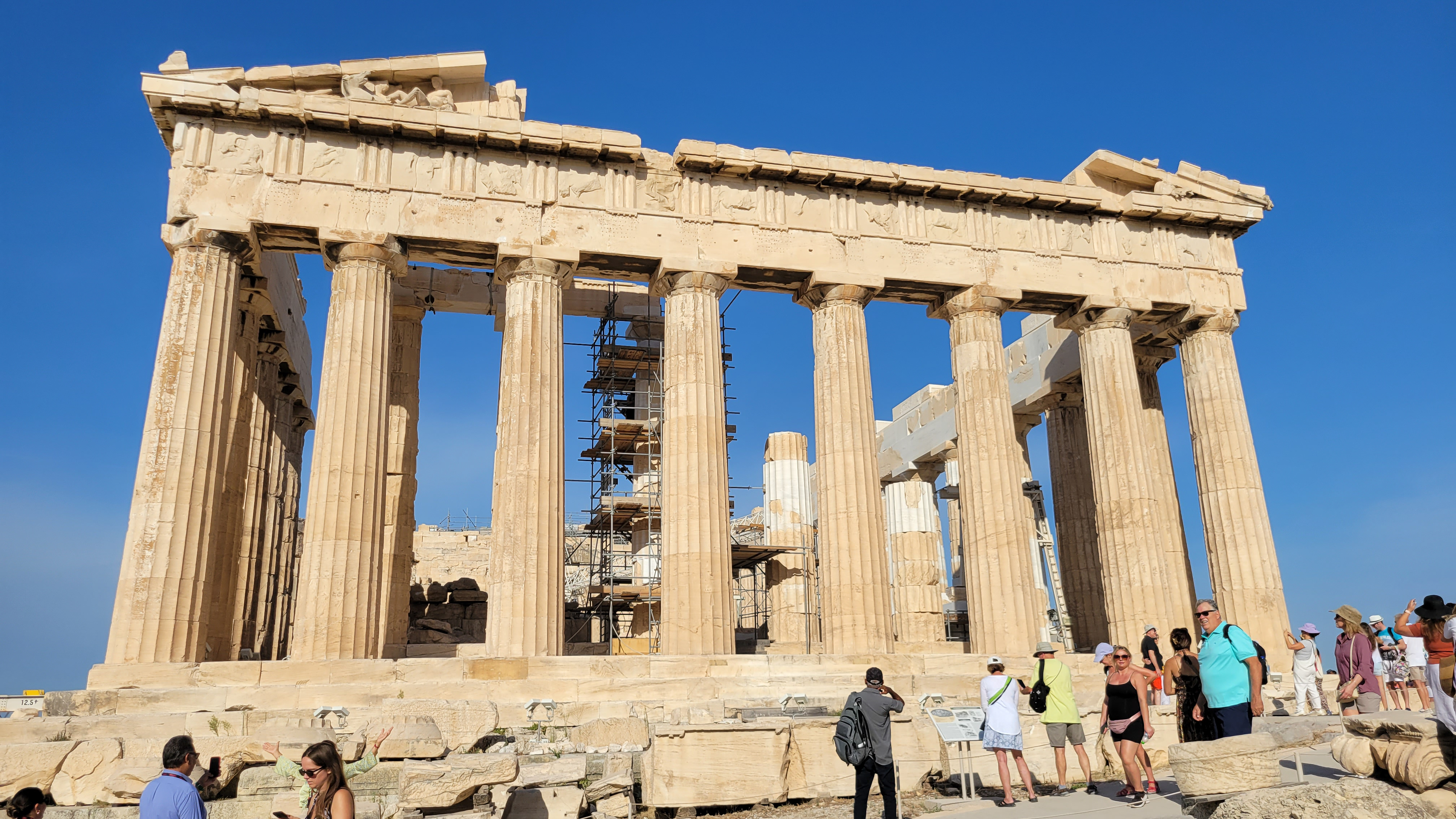
My own superficial views became evident on recent trip my wife and I took to Greece.  We were among the million American tourists who arrive annually to explore the Parthenon and other so-called ruins.  Our bus excursions reminded me of peeling the petals off an artichoke. Each petal’s morsel took us closer to the historical heart of the country.

The Parthenon dominates the skyline of Athens. It sits on a football-field sized platform called an acropolis. Considered the center of religious life in the city-state, the columned main temple, built more than 2,500 years ago, was constructed in honor of Athena, the goddess of wisdom, arts, literature, and war. Numerous sculptured human images, some still bearing original pigments and adorned with still fashionable clothing, are stored in a nearby museum.

We journeyed to Olympia, the birthplace of today’s Olympics. The place features acres of crumbled training facilities, temples, monuments, sanctuaries, and the buried outline of a big stadium. Originally built in 776 BCE, the site was dedicated to the worship of gods and athletic competition. Separate temples were erected for Zeus, the king of all gods, and Hera, the queen of the gods and goddess of women and marriage.

Every four years for centuries, the site drew competitors from dozens of Greek city-states, just as our current Olympics globally attracts athletes. However, back then only men competed; winning an event was a huge political honor (sometimes primed with bribes); athletes competed in the nude; a false start could trigger the death penalty.

A bus trip northward took us to the mountainous Oracle at Delphi. Considered the center of the earth by ancient Greeks, the main purpose of its temples was to honor Apollo, the god of prophesy, music, poetry, and knowledge. One could not communicate with him directly, so to predict the future a bridge between the human and the divine was necessary. The solution was a middle-aged female priestess seer named Pythia. Once a month she would foretell the future by breathing in potent fumes expelled by a fissure in the earth. After falling into a trance, she would scream unintelligible predictions which were translated by attending priests. A number of city-states maintained treasuries on the site because gifts to Apollo were expected for advice, especially in times of war or political upheaval.

Ruins attract thousands of tourists everywhere in Greece. New archeological discoveries appear every week. Why have disintegrated columns, walls, and statues become such magnets?

A little research brings reasons to light. The ruins tell fascinating stories about the country’s culture and values. Greek mythology, with its many legends about gods and goddesses, heroes and monsters, warriors and fools, is a vital cultural signature of the country. In the so-called Dark Age of Greece (about 1200 to 800 BCE), there was no written language, so story tellers used myths and legends to give meaning to everyday lives. Today’s ruins retell those stories.

Another reason for the sustained appeal of Greece is not just that it is indeed ancient, but that it still tells us so much about ourselves. It is impossible to identify any aspect of western civilization, and American life in particular, that has not been influenced by the ancient doings of Greece. The implications include our arts and architecture, political and legal institutions (including democracy and trial by jury), language and education, agriculture and philosophy, medicine and health, and (of course) athletics.

The sites we saw were visually awe-inspiring and even entertaining. Tourists support an estimated quarter of Greece’s economy, and we saw crowded evidence of it.  Our bonus in the months afterward has been a deeper understanding from thinking and reading about Greece’s gifts to western civilization.  After thousands of years, often without realizing it, we are living her legacy. 


Wednesday, October 11, 2023


A Tour of Iceland Changed Our Perspective

My wife and I recently returned from a week-long bus tour of Iceland.  Geologically stunning is an excellent way to describe the landscape that appeared in our bus picture windows.  Covering more than a thousand miles, we marveled at majestically rugged volcanic mountains and larva fields, countless waterfalls, steaming geysers and lush green hillsides.  Rustic overnight accommodations and indigenous foods were tasteful and interesting. 

All of this became a preface to our deeper understanding.  We were tourists, of course, but we began to realize that we were experiencing something more than a sightseeing trip with destinations.  This was a journey that offered a different perspective.  At every stop we felt as though we were building an understanding of how people interact with each other and their environment.       

Scholars call this cultural ecology. Think of it as open-minded awareness. Especially after returning home, we realized that few countries are more ecologically attuned than Iceland.  Icelanders connect with and deeply appreciate their environment.

 As we left the capital of Danish-flavored Reykjavik, where 60 percent of the country’s 370,000 residents live, we noticed clusters of the four million pine trees the country has planted since 2015. Centuries ago the Vikings stripped the land bare, so erosion is chronic.  Reforestation hints at the attention Iceland gives to their own renewable resource. Importing trees from overseas is forbidden.

Soon we visited one of the country’s six massive geothermal plants.  A resident geologist explained that more than a quarter of Iceland’s energy derives from underground sources. Combined with hydroelectric power, about 94 percent of the country’s residents have no home heating bills, nor do they need furnaces.  One of Iceland’s major exports is electricity.  Moreover, geothermal science has made Iceland a world leader in efforts to transform super-heated carbon dioxide into rock.

As we traveled on, sheep seemed to be scattered everywhere.  In the summer, after they return from highland grazing, the sheep are herded into clusters from which farmers cooperatively identify and separate their own by label.  We also saw small groups of pony-sized horses originally brought by Norse settlers.  Other breeds are forbidden from being imported, and exported native horses cannot be returned.  What makes these steeds distinctive is their unique gait which simulates riding on shock absorbers.

 We journeyed north to a coastal town surrounded by towering mountains.  Sheep farming, fishing, and music festivals are the norm in this isolated community for 200 residents.  Our host and his young daughter serenaded us, led a walking tour of puffin habitat and a fish factory, and explained how fairies and elves are an affectionate presence.  Thus social bonds, traditions, and economic necessity link community and environment.

Our tour director spent hours telling us hair-raising legends and sagas that describe the history of her country.   A full understanding of a country’s challenges can take a lifetime. Yet in a brief time we learned how life in a volatile land has enabled Icelanders to thrive. They take the country’s 32 active volcanoes in stride and track eruptions like weather reports.

We think the key to Iceland’s burgeoning success in tourism is how it integrates with, celebrates, and preserves its environment.  Even though our stay in Iceland was brief, we learned to appreciate not only the country’s natural beauty, but its sincere efforts to conserve and share that beauty while maintaining its traditional identity.  


Friday, March 10, 2023


What Your Hands Have To Say

By Jeffrey M. Bowen

When someone says, “Let me see your hands,” it may remind you of your mom when she wanted to make sure you had washed up before dinner. Or you think of the times you raised your hand to vote or to affirm an oath. In fact, we depend on our hands for an endless variety of reasons.

 Your hands can help you clarify what others are saying as well as your own intentions. As nonverbal clues to your emotions and dispositions, look no further than what your hands say about you.

As a high school student years ago, I competed in “original oratory”.  My coaches insisted on my using an array of gestures to get my message across. They were very right.  Rehearsed beforehand, the strategy worked beautifully if my gestures matched the inflections and cadence of my talk. Somehow the hand movements helped me maintain eye contact, and to speak out more clearly and confidently. 

Many decades later, as a school administrator, I was invited to judge original speeches delivered by student members of Future Farmers of America.  Those few who instinctively gestured as they spoke obviously knew their topic and felt confident and passionate about it. Unfortunately, when other students came to address our school board on some issue, they usually looked down, mumbled, and held onto their papers for dear life.

Besides convincing me that every student deserves the opportunity to learn public speaking, these experiences made me realize that using one’s hands will add excellent value to one’s speech and personal presence.

To make what we say more memorable, according to applied research by the Max Planck Institute, we should emphasize certain “beat” gestures while speaking.  Five distinct kinds of gestures were identified:  pointing at something or someone, mimicking an action, expressing an abstract concept, symbolic gestures (we all know what that middle finger means), and motor gestures to reinforce the stressed syllables (the beat) of what we are saying.

When words were matched with beat gestures, listeners were 20 percent more likely to hear and remember the words being spoken. When there was a deliberate mismatch, listeners were 40 percent more likely to misunderstand or misremember what was said.

As humans we are truly fortunate to have such adaptable appendages, including how expressive our fingers can be. Lately we have been tv streaming the show “Wednesday,” which features a colorfully creepy adolescent girl whose constant rescuer is a disconnected “Hand”.  There is no end to what that hand can communicate and pull off by relying on the eloquent signals sent by his fingers.

We are mesmerized by the tactile messages sent by hands. Consider the impact of touching others. When you gently touch someone as you speak to them, the message and the affection come across far more effectively than speaking from a distance.

A handshake carries many meanings (dating back to the 9th century B.C.E.). It may be a greeting, congratulations, or it may convey peaceful intentions or agreements between countries. Customs vary by culture. My experience suggests that using the right hand is expected and the strength of the grip is a measure of personality. When greeting one another, individuals who avoid handshakes altogether risk being viewed as unwelcoming and unappealing.

Employers place a high priority on hires who bring strong oral communication skills to the job.  Surveys have shown that experience in public speaking often outweighs problem solving and critical thinking. When I interviewed candidates, I used to watch how they presented their hands.

None of all this is mysterious. Hearing and seeing go together. Hand gestures are a  valuable cognitive and emotional asset. They represent fluency without a word being said.